
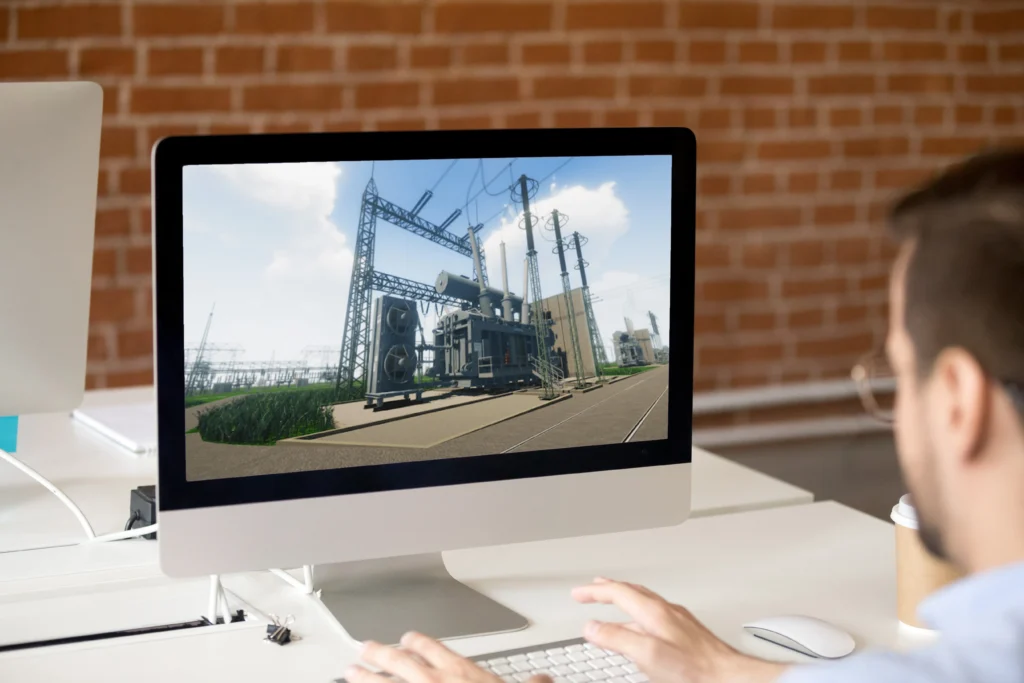
Traditional drawings, BIM views, and static renderings still matter. But when teams need broader stakeholder alignment, training, or operational planning, those outputs do not always provide enough context on their own. Many stakeholders can review a drawing and understand the design intent. Fewer can fully grasp what the finished environment will feel like, how people or equipment will move through it, or how future users will interact with it in the real world.
That is where Hexagon Multivista visualization and simulation services create more value. These services turn project models, drawings, scans, and other source material into interactive digital environments that support communication, planning, and training. They help teams clarify spatial relationships, evaluate design intent, improve coordination, strengthen stakeholder understanding, and validate decisions before work moves to the field.
As George Thomas, VP of Software, Hexagon Multivista, points out:
“The core challenge we are addressing is helping stakeholders clearly understand what the finished outcome will look like. We can illustrate this dynamically by showing animations like cranes in motion, people moving through the space, and vehicles operating within the environment.”
What visualization solves that static outputs often cannot
Visualization and simulation solve related but different problems.
On the visualization side, the biggest value is communication. For large projects, especially those that affect communities, campuses, or public infrastructure, teams often need to do more than present a design. They need to make it understandable to people who are not used to reading BIM models, 2D sheets, or technical documentation. A static rendering may show a building or a site. An interactive environment can place that asset in context and show how it fits into the surrounding environment, how movement will happen around it, and how the space will change over time.
That added context makes communication more useful for both technical and non-technical audiences. Instead of asking stakeholders to translate drawings into lived experience, visualization helps them see future conditions more intuitively. Hexagon Multivista visualization and simulation services take design evaluation, coordination, and stakeholder communication into account so teams can use the same environment to explain intent more clearly and align decisions earlier.
This is especially valuable in preconstruction, public outreach, and project communication. It can also support construction-phase storytelling by helping teams show what is changing next, what a sequence will look like, or how a future condition will come together over time. When a project needs more than a technical output, visualization helps turn information into understanding.
What simulation adds after visualization is in place
Once the visual model exists, simulation adds another layer of value.
This is where teams move from seeing the project to testing scenarios inside it. Simulation can support crowd flow, line-of-sight analysis, equipment routing, movement studies, and training. Instead of only explaining a future condition, simulation helps teams rehearse it before the consequences become physical, costly, or disruptive.
Hexagon Multivista visualization and simulation services are built to support more than presentation. They can help teams create walkthroughs, drills, orientation experiences, and simulated training environments that make operational and spatial decisions easier to test before live execution.
That matters because simulation moves the deliverable beyond communication and into decision support. A simulation can help a team test whether a route works, whether a signal will be visible from the right location, or whether operators can train on equipment and procedures before working in the physical environment. That makes simulation valuable not only for design communication, but also for readiness and execution.
Why input flexibility matters
One of the biggest strengths of visualization and simulation is flexibility at the starting point.
As George Thomas explains: “Our source material can be literally anything. It can be just photos, it can be videos, it could be LIDAR, BIM, Revit, CAD – just about anything.”
That flexibility matters because not every project begins with the same inputs. A new-build project may start with BIM, CAD, and design drawings. A renovation may combine drawings with point clouds and photos. A context model may use public mapping data, scanned surroundings, or captured site conditions to place the primary asset in a recognizable environment. The right source material depends on the level of detail required and the decision the model is meant to support.
More detailed inputs can also improve speed and accuracy. When teams have access to point clouds, BIM, or other precise sources, the resulting environment can be built more efficiently and with greater fidelity. When the use case is more conceptual, teams can still build effective visualizations using lighter inputs that prioritize context over precision. That flexibility makes the service useful across a range of project conditions and maturity levels.
It also means teams do not have to wait for a perfect data set to begin. Hexagon Multivista visualization and simulation services can adapt to the material available and shape the final environment around the specific communication, coordination, or training goal.
Where visualization and simulation fit best today
Visualization and simulation can support multiple project types, but some use cases stand out more clearly.
Visualization is especially effective for infrastructure and other large, context-heavy projects where teams need to communicate future conditions clearly across a broad environment. Simulation also has strong value in operational and training-focused scenarios, where teams need to test movement, procedures, or interactions before working in the real setting.
That makes these services especially useful when a project needs a more intuitive bridge between technical data and human decision-making. In one use case, the goal may be to help communities understand a proposed project. In another, it may to help internal teams validate movement, operations, or training procedures before handover. In both cases, the value comes from turning complex project information into an environment where people can understand and interact more naturally.
Why visualization is the bridge to connected digital twins
Visualization also matters because it is often the first step toward something more connected.
As George Thomas adds:
“The only thing that is different between visualization and the connected digital twin is connecting the live assets … it’s the fusion between the digital world and the real world.”
That progression matters because a visualization effort does not have to end as a one-time communication asset. The visual model can become the foundation for simulation. In the right use case, it can evolve into a connected digital twin by linking model elements to live asset data, work-order systems, or IoT inputs.
That protects the value of the initial modeling effort. Teams can begin with a clear communication need, expand into simulation when they need testing or training, and continue into connected operational use cases when the project demands more live context and asset visibility.
Conclusion
Visualization and simulation help AECO teams solve a practical problem: making complex projects easier to understand, evaluate, and act on before consequences move to the field. They can help communities understand proposed infrastructure, help teams test how a space or system will function, and help operators train inside a digital environment before they work in the physical one.
For teams that need more than static outputs, that is the real advantage. Visualization makes intent easier to understand. Simulation makes future conditions easier to test. Together, they create a stronger foundation for better decisions and a clearer path toward connected digital twins.
Ready to see how visualization and simulation can support your project? Book a free 30-minute consultation with our team to discuss stakeholder communication, scenario testing, training, and the path toward connected digital twin use cases.