
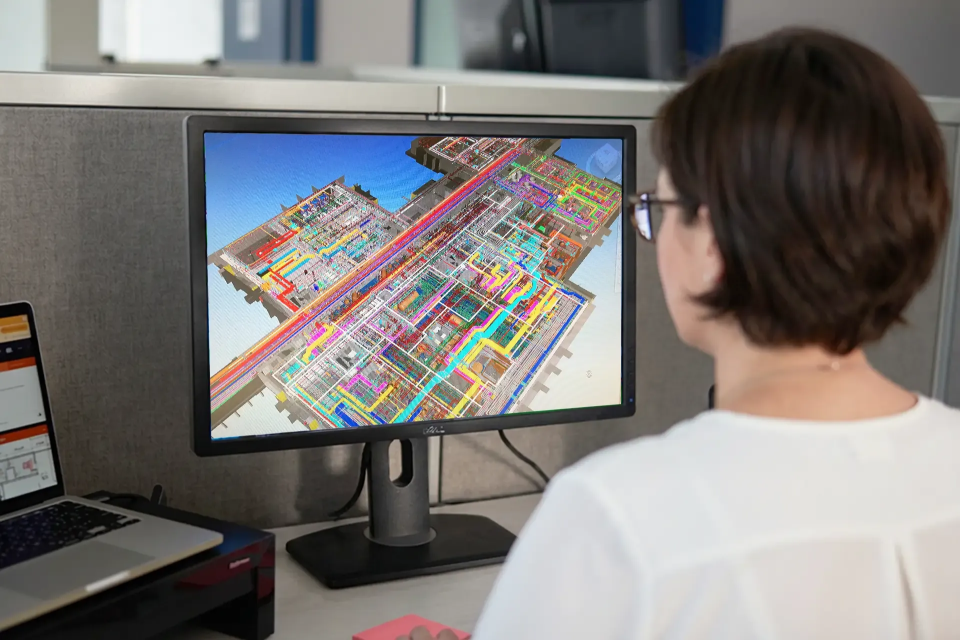
In healthcare construction, VDC teams are expected to deliver renovations and expansions without disrupting patient care. That means tight access to windows, complex MEP systems, and zero tolerance for surprises above the ceiling or behind finished walls.
Scan-to-BIM helps reduce that risk by turning reality capture into an accurate as-built model your team can coordinate from. When existing conditions are clear and reliable, coordination decisions hold up in the field, especially in active facilities.
Below are six execution-focused ways scan-to-BIM helps VDC teams keep healthcare projects moving.
1. Scan-to-BIM strengthens early planning by replacing assumptions withreal existing conditions
In healthcare facilities, the biggest coordination problems often come from what drawings don’t show: undocumented reroutes, legacy renovations, and above-ceiling congestion. Scan-to-BIM provides a reality-based baseline, so the team starts from what’s actually in place.
With an as-built model early, design intent can be checked against real constraints before it becomes procurement, fabrication, and install. That helps reduce late redesign, supports clearer trade buyout, and improves constructability planning in high-risk areas.
2. Scan-to-BIM improves phasing and shutdown planning in active facilities
Even when the project’s scope is straightforward, the execution rarely is. VDC teams still need to validate access, staging, infection control boundaries, shutdown constraints, and sequence logic – often down to specific rooms, corridors, and time windows.
A scan-informed model makes it easier to review phasing with facilities and operations, align on what’s feasible, and reduce last-minute changes that can ripple across trades and schedules.
3. Scan-to-BIM helps teams coordinate tight clearances and high-density MEP spaces
Healthcare environments are full of areas where inches matter: equipment rooms, interstitial spaces, risers, and congested above-ceiling zones. Scan-to-BIM provides accurate geometry that helps the team validate routing, clearances, and access before installation.
That clarity supports better clash detection outcomes and more confident coordination decisions – especially when prefabrication or complex tie-ins are part of the plan.
4. Scan-to-BIM reduces repeat site visits and field measurement churn
Healthcare projects often limit access to sensitive spaces, and above-ceiling verification can be disruptive. When the capture and model are consistent, VDC managers and detailers can validate dimensions, routes, and clearances without constant field requests.
Reducing “go re-measure this” loops keeps coordination moving, helps protect limited access windows, and avoids schedule drag caused by missing or uncertain information.
5. Scan-to-BIM speeds issue resolution with clearer context for RFIs and decisions
When issues come up, speed matters, but accuracy matters more. Instead of relying on a sketch or a single photo, teams can reference point cloud context and the as-built model to pinpoint the exact location and constraint.
That tends to shorten the path from “we found a problem” to “we agreed on a fix,” because the decision is grounded in shared, verifiable site conditions.
6. Scan-to-BIM keeps teams aligned as scope shifts and the project moves toward turnover
Healthcare work changes. Sequencing adjustments, owner requests, and field discoveries happen even on well-planned jobs. A scan-informed model makes it easier to re-check impacted zones, update coordination, and keep decisions current instead of relying on outdated backgrounds.
It also supports better record documentation, which matters when facilities teams need dependable as-built information after turnover for ongoing maintenance and change management.
About Hexagon Multivista Create services
Scan-to-BIM delivers a reality-based foundation. Hexagon Multivista Create services help extend that foundation into coordinated models, constructible documentation, and deliverables that support the full project lifecycle, from design through construction and into operations.
If you want to confirm the right scan-to-BIM scope, model standards, and handoffs for your healthcare project, schedule a free 30-minute consultation with our Create and VDC experts here.