
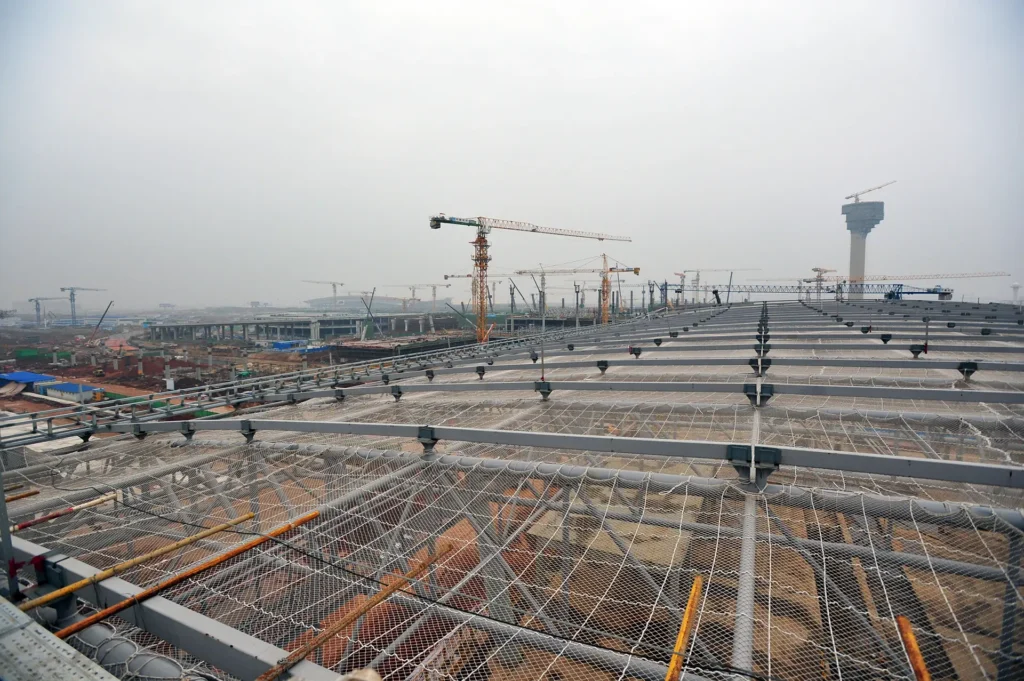
Airport modernization projects do not happen in neutral environments. They happen inside buildings that are active, security controlled, passenger facing, and operationally sensitive. People continue moving through terminals. Access rules continue to apply in restricted areas. Construction teams continue working around systems that support daily operations.
These complexities make site capture in airports different from many other AECO projects. The challenge is not only documenting real conditions accurately. It is capturing those conditions without disrupting airport functionality, passenger movement, construction work, or security procedures.
Hexagon Multivista helps airport teams address that challenge through Hexagon Multivista Capture services, including photo documentation, 3D laser scanning, UAV/Drone services, and webcams. These services help create a trusted visual and technical record that teams can use before, during, and after construction for airport modernization.
As Maria Emilia Quadri, Architect and Program Manager, Hexagon Multivista, explains:
“In airports, the biggest difference is operational security. From the reality capture side, accessing each area requires a high level of logistics, permits, and coordination, and the airport cannot simply stop functioning while that happens.”
Airports are live environments first
In a multifamily, commercial, or even many healthcare projects, access can still be complex. But airport environments add another layer. Project teams may need to coordinate around passengers, airport staff, active construction areas, restricted zones, boarding gates, security checkpoints, and airside operations.
That means capture teams need to plan around the building’s operating rhythm. In some areas, the best capture window may depend on passenger volume. In others, teams may need to wait for specific access approvals. Some spaces may require additional documentation before entry is allowed, while others may only be available on a specific date and within a specific time window.
This level of coordination changes how capture work is planned. It is not enough to know which rooms, corridors, ceilings, or systems need to be documented. Teams also need to understand when each area can be accessed, how long the capture will take, who needs to approve it, and how to avoid interfering with airport operations.
Access is part of the technical challenge
Airport capture is not only a fieldwork challenge. It is a logistics challenge that affects the quality of the final record.
Quadri notes that airport projects often require more documentation and stricter controls than other building types. That can include personal protective equipment requirements, access permits, security approvals, and coordination with the authorities or teams responsible for restricted spaces.
Some areas may be available only after additional documentation is submitted. Others may require coordination around flight schedules or passenger flow. If the team needs to capture conditions above ceilings, the schedule must account for the time required to remove and replace ceiling tiles, move safely through the space, and document the area thoroughly.
As Maria Emilia states:
“We have had to review flight schedules, both domestic and international, to identify the largest access window for a specific area. If the work involves scanning above the ceiling, that adds more time because celling tiles need to be removed, so the logistics become very detailed.”
That planning matters because incomplete capture can affect everything that follows. If rooms are missed, access windows are poorly coordinated, or field notes are inconsistent, the digital record becomes harder to assemble, validate, and use.
Capture often happens in pieces
A key airport challenge is that teams may not be able to move through the site in a simple, continuous sequence. Access may be granted in disconnected areas, at different times, under different operational constraints. One section may be available today, another next week, and another only after construction or security conditions change.
For Capture teams, that creates a second challenge: the work still needs to become one coherent record.
The field team must document precisely which areas were covered, what was captured, and what still needs attention. Then, during post-processing, those disconnected capture events need to be organized into a reliable output that supports downstream teams.
This is especially important when 3D laser scanning supports as-built documentation, renovation planning, or later Create services such as scan-to-BIM. Airport teams may capture in phases, but the final record still needs to help owners, designers, consultants, general contractors, and trades understand the environment as a whole.
Maria Emilia adds: “When access happens in separate sections, the challenge is making sure everything comes together coherently afterward. If the team needs an existing conditions record, it must be precise, even if the capture had to happen in parts.”
Visibility helps teams make decisions without returning to the site
One of the most practical benefits of airport capture is that it reduces the need to physically revisit sensitive or hard-to-access areas every time a question comes up.
A visual and technical record can help teams answer questions about existing conditions, above-ceiling spaces, room layouts, equipment locations, circulation areas, and renovation constraints. Instead of relying only on older drawings or sending multiple stakeholders back into an active terminal, teams can consult captured site data and make faster decisions with more context.
That can support:
- Renovation planning
- Access and phasing discussions
- Existing conditions validation
- Design coordination
- Stakeholder reviews
- Construction documentation
- Handover and future maintenance planning
For airport modernization teams, this matters because access is expensive in time, coordination, and operational impact. When the site record is available and organized, teams can review conditions without repeating the same access process every time.
The cost of inconsistent capture
When airport teams do not have consistent site capture, risk tends to move downstream. Older drawings may not reflect current conditions. A duct, pipe, wall, ceiling condition, or equipment location may be different from what the team expected. Planning then happens around information that is incomplete or outdated.
In airports, those gaps can be especially costly because systems, security needs, passenger flow, and construction phasing are tightly connected. A small unknown in a typical building may create coordination friction. In an airport, that same unknown can affect access, safety, schedule, operations, or future renovation work.
Consistent capture helps reduce such uncertainty. It gives project teams an objective record of real conditions, which can then support models, documentation, analysis, and decision-making throughout the project lifecycle.
The JFK Terminal One case study shows why this matters at scale. On one of the largest aviation redevelopment projects in the United States, reality capture supported a repeatable approach to monthly as-built model delivery while construction continued, helping the team keep documentation closer to what was installed in the field.
Conclusion
Airport modernization starts with visibility, but visibility in an airport is never simple. Capture teams must work around live operations, security requirements, passenger movement, construction activity, and fragmented access windows while still producing a reliable record of existing and changing conditions.
That is why Capture services are so important in airport projects. They help teams document what is actually there, reduce unnecessary site revisits, support downstream modeling and coordination, and give stakeholders a shared reference point for decisions.
For airport owners and project teams, the value is not only having photos or scans. It is having a capture process that respects the reality of airport operations while creating information the project can trust.
Ready to see how Capture services can support your airport modernization project? Book a free 30-minute consultation with our team to discuss photo documentation, 3D laser scanning, UAV/Drone services, webcams, and the best way to document real site conditions without disrupting live operations.