
Home > Resources > Case Studies > Article
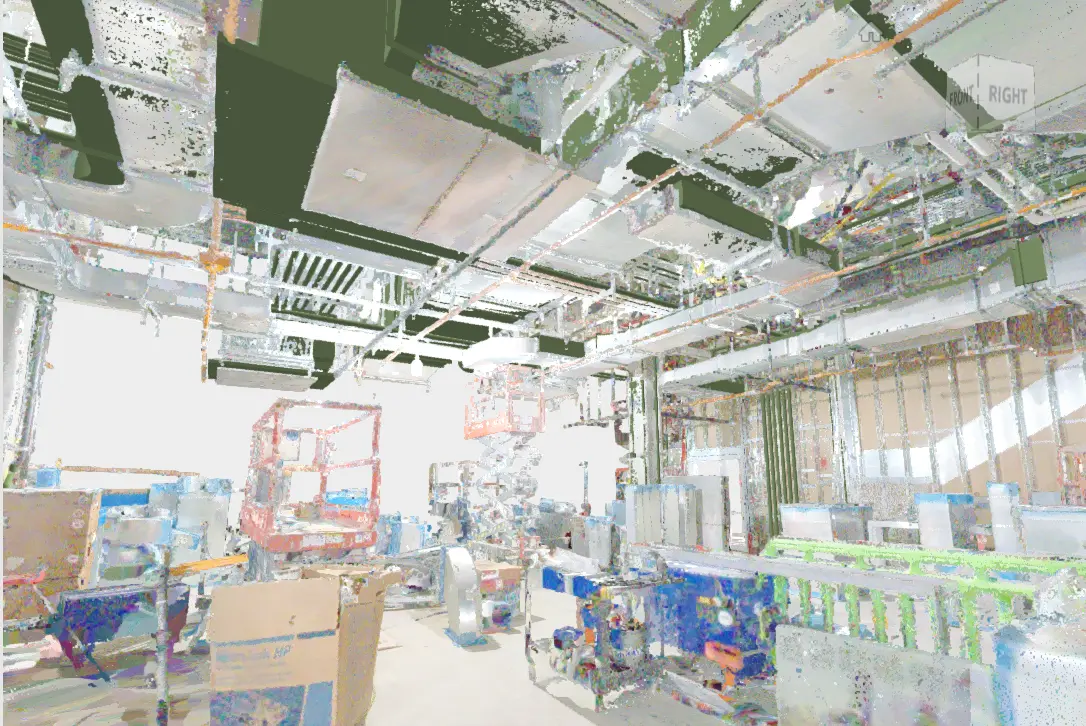
Large airport construction projects are under growing pressure to deliver more documentation and more reliable data, often while schedules continue to compress, and system complexity increases. On many such projects, traditional approaches to as-built documentation cannot keep pace with how work is actually executed in the field.
At JFK Terminal One, AECOM Tishman faced a requirement that tested those limits: delivering accurate, monthly as-built models while construction was actively underway on one of the largest aviation redevelopment projects in the United States. Using conventional methods, meeting this requirement at scale would not have been possible.
By automating as-built creation directly from reality capture, Hexagon Multivista Analyze services allowed the project team to turn a requirement that was previously unworkable into a process that could be executed consistently throughout construction.
JFK Terminal One is a large, fast-track design‑build aviation project with significant scope, tight coordination requirements, and numerous stakeholders. As construction manager, AECOM Tishman was responsible not only for managing installation across dozens of systems but also for meeting ongoing documentation and reporting expectations from the project’s governing authority, the Port Authority of New York and New Jersey.
The challenge was obvious: AECOM Tishman needed to deliver accurate as‑built models on a monthly basis, while construction was still fully in progress. These required monthly models needed to reliably reflect current field conditions, even as installations continued and designs evolved.
Helping to lead AECOM Tishman’s digital delivery efforts was EnTech, a digital engineering and technology firm, with Megan Salazar serving as the VDC and BIM manager deployed on the AECOM Tishman team.
“On projects like this, there is very little room for error,” Salazar said. “You have constant design changes, tight schedules, and many systems being installed at the same time. Keeping as-built models accurate during construction is extremely difficult.”
That difficulty is common across large airport projects. Subcontractors are focused on building and coordinating work in the field, not maintaining documentation. Internal BIM and VDC teams are already managing heavy coordination workloads. Expecting either group to continuously update as-built models during active construction is rarely practical.
The alternative is typically third-party reconstruction. On a project of this size, that would have required a dedicated team whose sole responsibility was to update models to match field conditions, often working weeks or months behind actual installation.
“At this scale,” Salazar said, “that approach just does not work.”
AECOM Tishman initially engaged Hexagon Multivista to improve progress tracking during construction. At that point, the goal was to move away from subjective status updates and instead use laser scans and 360‑degree imagery to measure installation progress by trade and scope.
But as the team began using the platform, it became clear that progress tracking was only one part of the value.
“The automated as-built IFC models were the real differentiator,” Salazar said. “No other solution we looked at could deliver that as a consistent project deliverable.”
Rather than treating scans and photos as static records, Hexagon Multivista used that data as direct input for automated as-built model creation. As reality capture was collected, models were generated to reflect what had actually been installed in the field.
All relevant data, including models, point clouds, drawings, and imagery, were available in a single environment. That eliminated the need to cross‑reference multiple platforms or rely on subcontractors to manually update models.
Just as importantly, this approach removed the need for a separate documentation phase. As-built models were created as work progressed, rather than being reconstructed later.
And, just as crucially, creating these progress reports did not interfere with field operations. Teams continued capturing scans and imagery as part of normal project activities, while automation handled the model creation and construction carried on.
Under traditional workflows, producing accurate monthly as-built models on a project of this size would have required multiple full-time specialists over several years, dedicated to continuously rebuilding models to match field conditions. Even with that effort, documentation would almost always trail what had been installed.
With Hexagon Multivista, there was no such team required – or any delay in documentation whatsoever.
“All we had to do was keep capturing the field the way we already were,” Salazar said. “Hexagon handled the rest.”
By removing manual modeling from the process, the team not only reduced labor requirements but also eliminated the time gap between construction and documentation. As-built conditions were available continuously, rather than being updated weeks later. This allowed accurate models to deliver on a predictable monthly cadence without adding staff or slowing construction.
These automated models were submitted regularly to the project’s governing authority. They received strong feedback from the Port Authority, with deliverables described as some of the highest‑quality as-built submissions across active JFK projects.
Internally, for the AECOM Tishman team, the models also improved coordination. Teams used the visual data to validate progress, resolve scope questions, and support discussions with subcontractors based on what had actually been installed.
“Construction teams respond to visuals,” Salazar said. “Being able to clearly show what is in place makes coordination much easier.”
These interim as-built models ultimately served as the basis for the final as-constructed models, rendering the end-of-project delivery of a final model much easier. After all, modeling teams from different subcontractors were able to use these interim models as their bases, as opposed to large, slow laser scans or field-measured, as-built conditions.
The JFK Terminal One project highlighted a broader issue facing airport owners and delivery teams: As aviation projects grow larger and more complex, traditional approaches to as-built documentation become harder to sustain.
By automating as-built creation directly from reality capture, Hexagon Multivista allowed AECOM Tishman to meet ongoing documentation requirements throughout construction.
We can walk you through a tailored plan based on your workflow, stakeholders, and project phase.
Meet us at Autodesk University 2026, booth #4309 |