
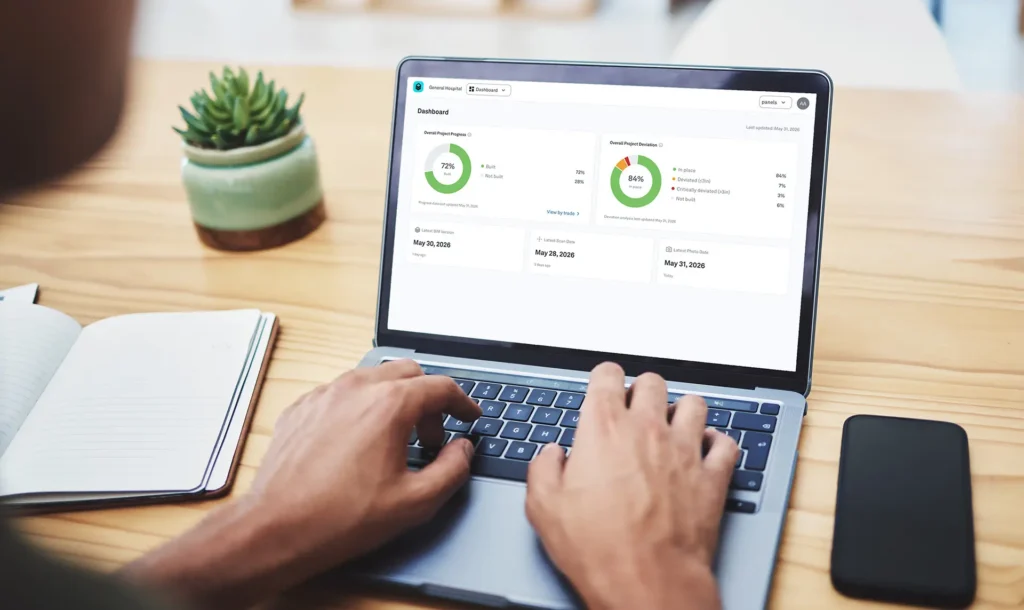
Construction teams capture more project data than ever. Photos, scans, models, schedules, and reports can all help teams understand what is happening in the field. That captured data has real value on its own as an objective project record, especially when teams need to verify conditions, document changes, or resolve questions later. But during building construction, the next challenge is turning that data into decisions.
When progress is hard to verify, schedule reviews become subjective, coordination risk grows around installation issues that are difficult to see, and stakeholders reviewing pay applications can spend more time debating status than solving problems when updates depend on manual reporting or incomplete evidence.
Hexagon Multivista helps address that challenge through Analyze Hub. As part of Hexagon Multivista Analyze services, Analyze Hub helps construction teams compare photos, 3D laser scans, and BIM to understand progress, review deviations, and make captured project data more actionable. It also connects to the broader Hexagon Multivista Hub experience, helping teams bring analyzed construction insight closer to the project information they already use.
As Mackenzie Stickney, Product Manager for the Hexagon Multivista Analyze Hub, licensed architect, AIA, CPHC, puts it:
“Analyze Hub is the analysis layer for captured photos and scans. It helps make that data actionable by showing how far along a project is and how accurately work is being installed.”
Captured data is valuable. Analysis makes it actionable
Photos and scans are valuable because they document real field conditions during building construction. They show what was visible at a specific time, in a specific location, and from a specific capture event, creating an objective record teams can reference for progress, claims, disputes, or future questions.
When that information is analyzed against BIM, it can also help teams understand what has been installed, what is behind schedule, what differs from the model, and where the team should focus next. It can also support coordination by helping teams see what should be built and where field conditions differ from what was proposed.
Analyze Hub helps close that gap by comparing photos and 3D laser scans against BIM. Instead of treating photos and scans as static records, teams can use them as inputs for progress and deviation insight. That shift matters because construction decisions often happen under pressure. Teams need information that is current enough, clear enough, and objective enough to support conversations while work is still underway.
Good analysis starts with good capture
Analyze Hub works best when project teams start with consistent, high-quality photos and scans. This is where Hexagon Multivista Capture services can play an important role.
Photo documentation gives teams organized visual records that can be reviewed by location and date. 3D laser scanning provides detailed spatial data that can support construction verification, deviation analysis, and as-built insight. When those inputs are consistent, the analysis becomes stronger.
That does not mean every project has to start the same way. Some teams may already have capture workflows in place. Others may need support from the beginning. The key is understanding that analysis quality depends on input quality.
As Mackenzie explains:
“The analysis is only as good as the capture. When teams start with better photos and scans, they give Analyze Hub a stronger foundation for progress and deviation insight.”
Comparing what was modeled to what was built
One of the core values of Analyze Hub is the ability to compare captured field conditions against the project’s BIM. That comparison can help teams see whether work is advancing as expected, whether build-out aligns with the model, and where attention may be needed.
For example, a project team may need to review a mechanical room, corridor, or active floor without sending every stakeholder back to the site. By comparing field photos or 3D laser scan data against the existing BIM, teams can better understand what has been installed and how it relates to the coordinated model.
This supports both progress visibility and deviation review. Teams can use the comparison to identify whether modeled work is in place, where installed elements may differ from the model, and which areas need coordination. The value is not replacing construction judgment. It is giving stakeholders a clearer reference point for the conversations they already need to have.
Progress reporting as a shared benchmark
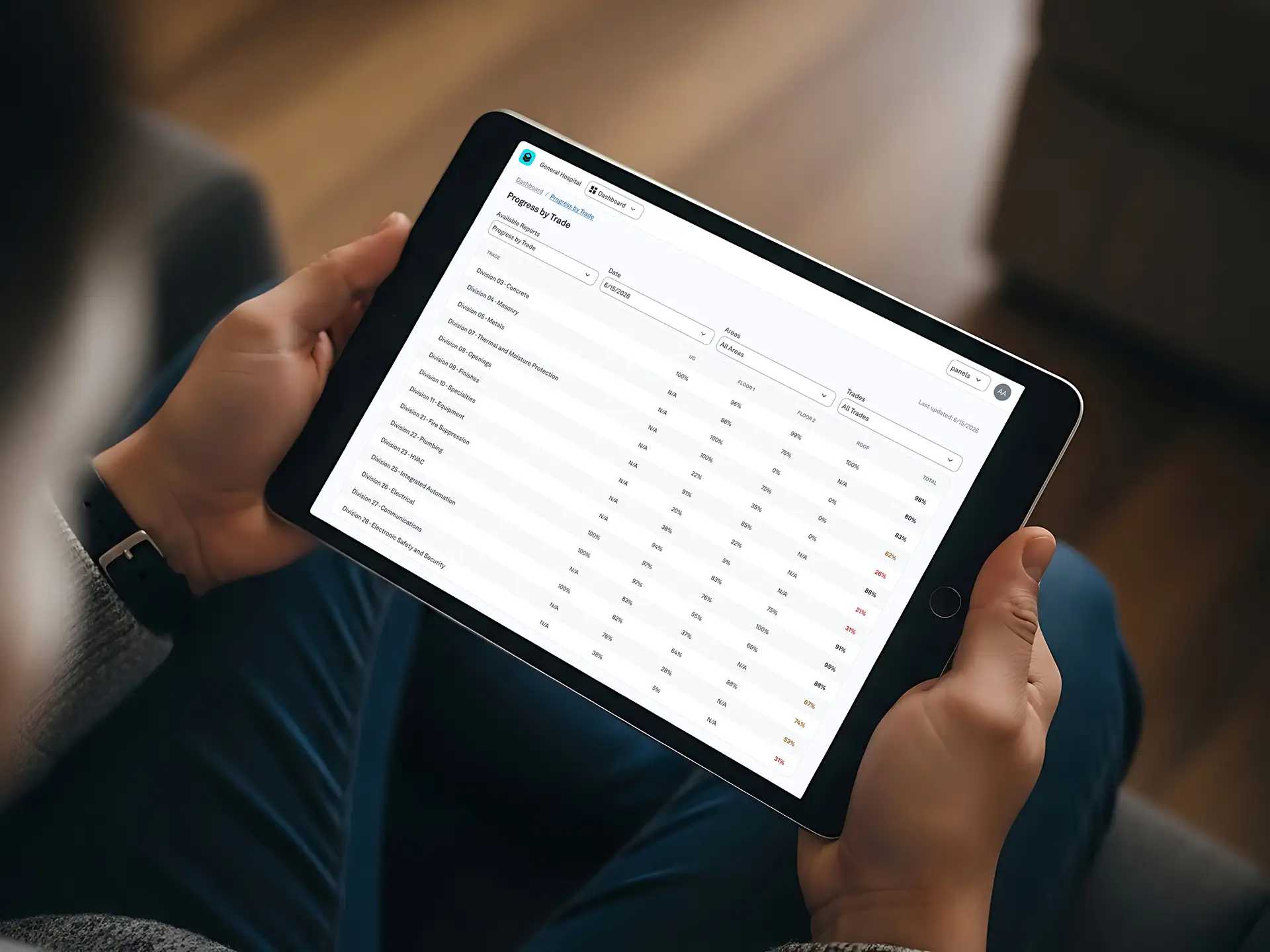
Progress conversations can become difficult when teams rely only on manual updates. One person may describe work as nearly complete, while another sees remaining installation, insulation, testing, or finish work that changes the real status. That disconnect can affect schedule reviews, pay applications, and stakeholder confidence.
Building progress reporting helps teams compare built work against BIM and project expectations so progress can be reviewed by trade, floor, or area. That gives owners, general contractors, schedulers, project executives, and trade partners a more consistent benchmark.
For schedule reviews, this helps teams understand where work is advancing and where progress may be drifting. For pay applications, it gives stakeholders stronger evidence to support payment conversations. For project leadership, it helps create a more objective view of performance across complex scopes.
Objective progress reporting does not remove the need for team alignment. It improves the quality of the information that team alignment depends on.
Deviation insight before issues compound
Progress is only one part of the story. Construction teams also need to know whether installed work aligns with the model closely enough to avoid downstream coordination problems.
Deviation analysis compares scan data against BIM to help teams identify where built conditions differ from the model. That insight can support coordination, quality reviews, and rework prevention when issues are still easier to address.
This is especially important in MEP-heavy environments, tight ceiling spaces, mission-critical facilities, and projects with dense system coordination. A small installation difference may not seem urgent in isolation, but it can affect future trades, inspections, commissioning, or access.
Analyze Hub helps make those differences easier to see and discuss. Instead of relying only on a field walk or anecdotal feedback, teams can review deviations in visual context and decide what needs action.
Service-supported analysis, not just software
Analyze Hub is not only about technology. It is also about the services behind the analysis.
Construction data is complex. Models vary. Capture quality varies. Project needs vary by stakeholder, phase, and risk profile. That is why expert support matters. A service-supported approach helps teams interpret photos, scans, and BIM comparisons in a way that is useful for real construction decisions.
As Mackenzie notes:
“Analyze Hub is a service offering, not just software. The technology matters, but the value comes from combining that technology with people who understand construction data and can help teams turn it into usable insight.”
That combination helps reduce the burden on internal VDC, project controls, and field teams. Instead of asking those teams to manually process every photo, scan, and model comparison, Analyze Hub supports a more structured path from captured data to reporting and review.
Who benefits from Analyze Hub
Different stakeholders use Analyze Hub in different ways:
- Owners gain a clearer view of progress, quality, and project risk. This can support executive reporting, payment conversations, and confidence in what is happening on site.
- General contractors can use progress and deviation insight to coordinate trades, confirm schedule updates, and identify issues earlier.
- Architects and engineers can review construction conditions with more visual context, helping support construction administration and coordination with consultants.
- MEP trades can benefit from clearer documentation of work in place, installation differences, and progress status.
The common thread is shared context. When stakeholders can review the same photos, scans, BIM comparisons, and reports, conversations become more grounded and less subjective.
Conclusion
Captured data is powerful, but only when teams can use it.
Analyze Hub helps construction teams move beyond static documentation by turning photos, scans, and BIM into progress and deviation insight. It gives stakeholders a more objective benchmark for schedule reviews, pay applications, coordination, and quality conversations.
The goal is not to replace the expertise of project teams. The goal is to give those teams better information earlier in the process, so they can make decisions with more confidence.
Ready to turn photos, scans, and BIM into construction insight? Book a free 30-minute consultation with our team to discuss Analyze Hub, building progress reporting, deviation analysis, and how objective reporting can support your project.