
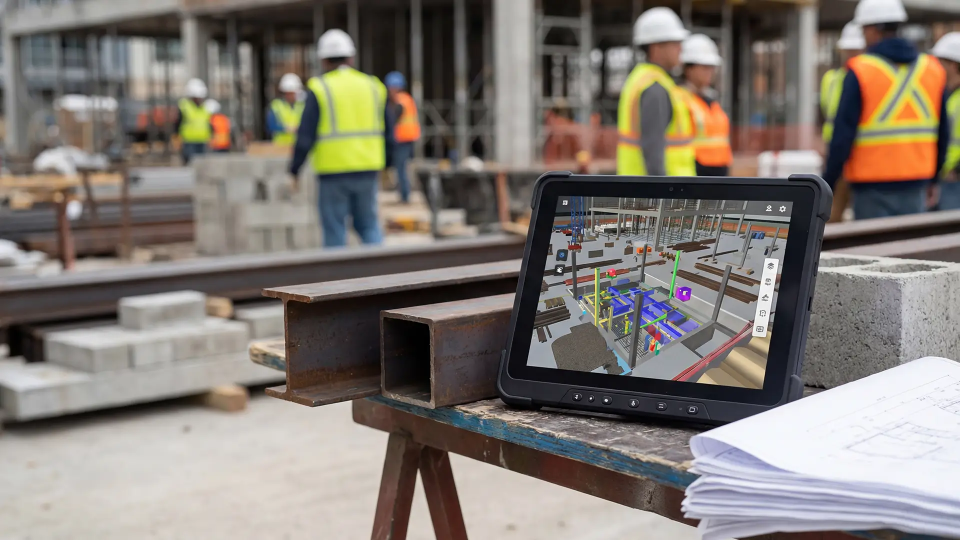
Large-scale commercial construction projects in EMEA rarely begin with perfect information. Teams are often renovating occupied space, upgrading legacy building systems, or coordinating phased work across multiple sites that must remain operational throughout construction. When existing drawings are incomplete or out of date, the project starts with assumptions, which can quickly turn into RFIs, clashes, delays, and rework.
Scan-to-BIM replaces guesswork with reality. By capturing existing conditions through laser scanning and other reality capture methods, then translating that data into a usable BIM model, teams can make more confident decisions from design through delivery. That matters even more on large commercial programs, where a small issue in one area can multiply across repeated floor plates, multiple properties, and complex stakeholder groups.
As Mariano Franchini, Director of Scan-to Services for Hexagon Multivista, explains, “In large-scale commercial construction, the cost of an error scales just as fast as the building itself. Scan-to-BIM is a risk-mitigation powerhouse that ensures we are building on a foundation of ground-truth data rather than outdated blueprints.”
Why scan-to-BIM matters at scale
On a single floor, a minor discrepancy can be an inconvenience – an undocumented soffit, an offset column, or a rerouted duct. On a large commercial program, those discrepancies compound. Repeated across multiple areas or multiple buildings, they become schedule risk, cost exposure, and coordination problems that are harder to solve once work is underway. Scan-to-BIM helps reduce that risk by creating a consistent, reality-based baseline: point clouds and BIM models that reflect actual existing conditions on site, not assumptions carried over from outdated documentation.
This is especially important in EMEA, where many commercial projects are modernization projects. Buildings often have layered renovations, mixed documentation, and building systems that have evolved over time. Traditional field verification can be slow and disruptive in active environments. Reality capture allows teams to document conditions quickly and create BIM deliverables that support coordination across architecture, structure, and MEP systems before conflicts show up in the field.
That shared baseline is one of the biggest advantages of large programs. As Constanza Gonzalez, Program Manager of Scan-to Services for Hexagon Multivista, puts it, “Large-scale projects demand a single source of truth. Scan-to-BIM provides that by creating a precise digital replica of the physical environment, allowing for seamless coordination across disciplines and reducing costly field re-work to nearly zero.”
What scan-to-BIM changes in project execution
Scan-to-BIM is not only about producing a model. It improves decisions that depend on accurate existing conditions. With a reliable baseline, teams can validate design intent earlier, reduce late scope changes, and plan installation with fewer surprises.
It also helps accelerate the pace of decision-making. Instead of spending weeks on manual verification, teams can move from site capture to usable design intelligence much faster. As Constanza Aguero, Program Manager of Scan-to Services for Hexagon Multivista, explains, “We are essentially collapsing the timeline between site capture and actionable design. By converting millions of data points into a high-fidelity BIM model, we empower stakeholders to make critical decisions in days that used to take weeks of manual verification.”
In practice, that can lead to fewer site revisits, clearer constructability reviews, stronger coordination across trades, and better planning for access, shutdowns, and phased sequencing. For owners, it also creates a stronger digital foundation for future renovations, tenant improvements, and long-term asset planning.
A real-world example: portfolio digitization for a major retailer
A recent portfolio program for a major retailer illustrates the impact scan-to-BIM can have on large commercial work. The organization set out to accelerate asset digitization as part of its transition to BIM and improve the accuracy of the information used to manage its commercial properties. The scope covered seven sites, ranging from roughly 27,000 to 81,000 square meters, which required a repeatable approach that could scale across multiple buildings.
To create an accurate baseline, the project used lidar laser scanning along with 360° site documentation. That reality capture data supported LOD 300 to 350 BIM models spanning architectural, structural, and building systems content, creating a dependable representation of element location, size, and material characteristics.
The value went beyond geometry. The deliverables were also parameterized so the data could support more accurate surface calculations, integration with management tools, and a detailed inventory of maintainable elements. In other words, the program did not stop at modeling the building. It focused on structuring information in a way that could support both project delivery and the building’s ongoing lifecycle.
Getting value from scan-to-BIM: Define the end use first
The difference between an accurate model and a useful model is clarity on the intended use. Before capture begins, teams should align on what the model needs to support, whether that is renovation planning, coordination, area validation, facilities management, or a combination of those goals. That alignment drives decisions about scope, level of development, element prioritization, and data structure.
For large commercial work, this upfront definition helps avoid overmodeling and improves handoffs between stakeholders. Design teams work with fewer assumptions. Contractors and trades coordinate more effectively. Owners and facilities teams receive deliverables that stay relevant after handover because they are built around real downstream needs, not just geometric accuracy.
How Hexagon Multivista supports scan-to-BIM
Hexagon Multivista’s scan-to-BIM services combine reality capture with modeling workflows that help teams move from field conditions to BIM deliverables with purpose. Whether the goal is design coordination, existing conditions validation, record documentation, or long-term asset visibility, the objective is the same: deliver reality-based information teams can trust.
For large-scale commercial construction projects in EMEA, scan-to-BIM improves more than documentation. It improves confidence. When teams start with accurate existing conditions, they can reduce unknowns, coordinate earlier, and plan work with fewer surprises. On complex commercial programs, that means better decisions, less rework, and a stronger foundation for both delivery and long-term asset value.
If your team needs a reality-based starting point for renovation, refurbishment, or portfolio digitization, schedule a 30-minute free consultation with our experts here.