
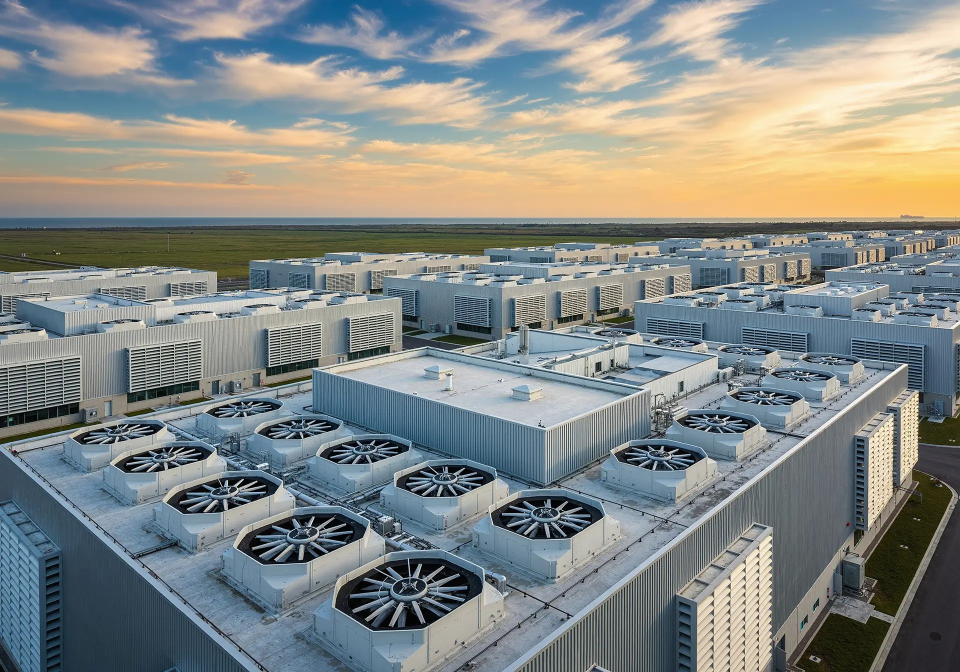
Data centers do not give project teams much room for uncertainty. These facilities are large, dense, and highly coordinated, with strict quality expectations from owners and little tolerance for delays once systems start going in. That is exactly why Hexagon Multivista Analyze services can add so much value during construction.
As Dimitrios Papadopoulos, Sr Director, BIM/VDC for Customer Ops, put it, “The main issue that the customers have for data centers is their construction quality needs to be very precise.” That precision affects more than one trade or one floor. It affects how teams verify installation quality, track progress, and keep the project moving toward handover with fewer surprises.
Why precision matters more in data centers
Many building types can absorb a small miss and recover later, but data centers usually cannot. Dimitrios described them as large-scale facilities with strict client expectations around both the location of elements and the pace of construction. When systems are dense and tightly coordinated, even a small deviation can create downstream problems for routing, equipment fit, trade sequencing, and schedule performance.
That is why reality-based analysis is so useful. “We compare the point clouds, produced frequently during construction, to the most up-to-date coordinated BIM, to verify the location accuracy of each element on site,” Dimitrios said. In practical terms, that means the team can verify whether key systems and structural elements are where they are supposed to be before field issues become rework.
Where Analyze services help most
For data center teams, the value of Analyze services usually shows up in two connected ways: quality verification and schedule visibility.
The first is deviation analysis. This service compares captured reality to the coordination model to detect out-of-tolerance or missing work. That helps teams reduce rework, document acceptable field changes, and support more accurate as-built updates.
The second is building progress reporting. This service compares captured site reality to models and schedules, so teams can measure planned versus actual progress by trade. Instead of relying only on manual updates, project teams get a clearer picture of what is built, what is behind, and where attention is needed next.
Together, those two services give contractors a more objective view of both quality and momentum. On a project type where speed and precision both matter, that combination is hard to ignore.
Why underground conditions matter too
Data centers are often described by what happens inside the building, but Dimitrios pointed out that the underground level is also critical. Utilities, cables, and fiber can come in from long distances and run below the building before being enclosed. Once that work is covered, it becomes much harder to know exactly what was built and where.
That is one reason documentation and analysis have lasting value. The same information used during construction can support troubleshooting, future expansion, and better as-built records later. As Dimitrios explained, “We provide critical information that facilitates the organic production of the as-built BIM by the end of the construction.”
Why stakeholder alignment is part of the service
Analyze services are not just about technology. They also depend on the right project relationships. Dimitrios said, “We need to work closely with the BIM VDC managers of the GC because they are the ones who are responsible for the coordinated BIM.” That coordinated model is what makes model-to-reality comparison useful in the first place.
The work also connects with schedulers, project managers, and innovation leaders, because analysis only creates value when the results feed actual project decisions. If the team is using 360° photos, point clouds, model data, and schedule data in parallel, the output becomes much more than a report. It becomes a practical decision-making tool.
Why starting earlier improves outcomes
Timing matters, too. “The earlier we get involved in the BIM coordination and reality capture process, the better we can support all teams and the more data we will be able to analyze,” Dimitrios said. On a data center project, bringing Analyze services in just before construction starts gives teams a stronger baseline for tracking quality and progress from the beginning, rather than trying to piece the story together later.
That early start also creates better continuity across Capture, Create, Analyze services. Reality capture provides the field data. Coordinated BIM provides the digital reference point. Analyze services turn both into insights the team can act on during construction and use again at handover.
Final takeaway
For data center construction, precise installation is only part of the challenge. Teams also need reliable ways to confirm what is built, understand how work is progressing, and hand over better information at the end of the job. Analyze services help support all three.
When deviation analysis and building progress reporting are connected to point clouds, 360° photos, coordinated BIM, and the right project stakeholders, teams can reduce rework, protect schedule performance, and improve confidence in the final as-built record. In a data center environment, that kind of clarity is not a nice-to-have. It is part of building the facility correctly.
Want to see how Analyze services can support your data center project? Book a free 30-minute consultation with our team to discuss deviation analysis, building progress reporting, and the best way to apply reality-based insights to your workflow.