
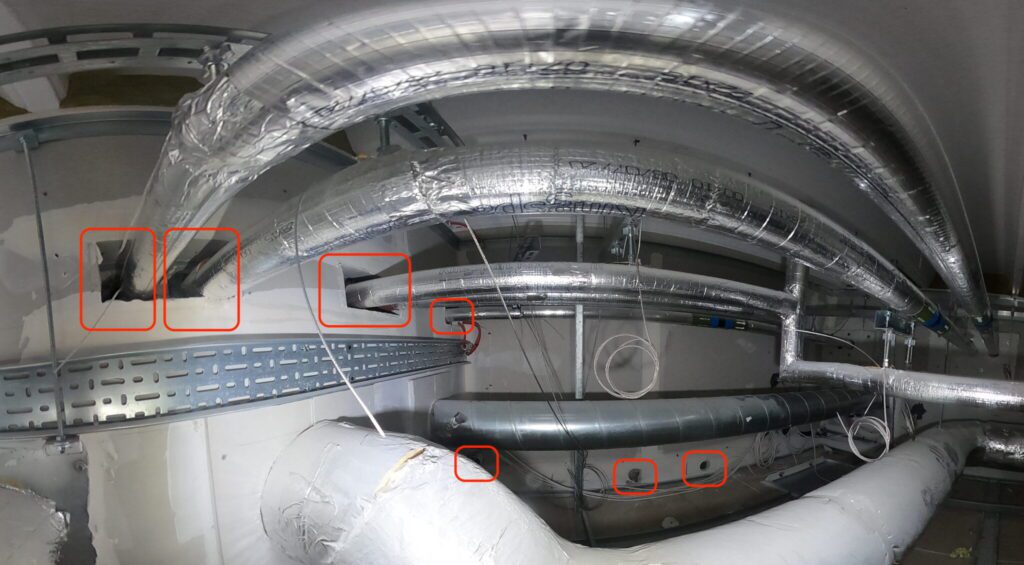
When you think about hospital safety, your mind probably jumps to patient care, life-saving procedures, and highly trained staff. But there’s another piece of the safety puzzle that flies under the radar: firestopping.
In hospitals, clinics, and large medical facilities, fire-rated barriers play a crucial role in ensuring compliance, promoting patient and staff safety, and even determining eligibility for programs such as Medicare and Medicaid.
Firestopping is the practice of sealing any openings or penetrations in fire-rated walls and floors to prevent smoke and flames from traveling between rooms. Every wall in a building carries a different fire rating. Some need to hold smoke at bay, others need to block fire for up to four hours. In hospitals, where evacuating patients takes time, those barriers buy precious minutes.
During Joint Commission inspections (typically every three years), compliance teams physically inspect above-ceiling spaces, scanning for unsealed gaps. The expectation is complete compliance, with zero visible violations.
The Hidden Problem with Manual Inspections
The riskiest penetrations are almost always hiding above MEP infrastructure. That means they’re tucked behind ductwork, wiring, and plumbing, places you can’t see by popping a ceiling tile.
That’s why more facility teams are turning to reality capture for construction and high-resolution construction photo documentation to get a complete picture of their fire-rated barriers. With tools like laser scanning and 360 construction photos, teams can capture everything above the ceiling and catch what the eye might miss.
What Happened When One Hospital Put Reality Capture to the Test
Recently, the internal team of a one-million-square-foot hospital system had already sealed what they believed were all above-ceiling firestopping violations. Then they brought in Multivista for a second look.
By documenting every ceiling space using photo-based construction site documentation tools and comparing the images to floor plans, the technology identified over 2,000 issues that had been previously missed. Each issue was logged by severity, pinned to a floor plan, and queued up for fix-and-verify.
This wasn’t just a win for compliance. It was a smart financial move. The entire reality capture scope cost around $80,000. If the hospital had failed inspection, it risked losing $500,000 to $700,000 a day in billable patient revenue.
Why Better Data Means Better Firestopping Workflows
In that real-life example, once deficiencies were documented, the facilities team could tackle them room by room with a digital construction progress report in hand. This included photos, floor plan pins, and a simple strike list, all of which were accessible within the Multivista mobile app.
They fixed what needed fixing, documented the repairs, and were entirely prepared for inspection day.
The Bottom Line
Firestopping isn’t just about putting out hypothetical fires. It’s about safeguarding the lives within your buildings, preserving revenue, and ensuring operations continue without disruption. Especially in healthcare, where renovations and retrofits occur frequently, you need a reliable record of your fire-rated assets.
With the right tools, such as laser scanning, photo documentation, and construction deviation analysis software, your facilities team can stay informed, proactive, and inspection-ready.
If you’re not 100% sure what’s hiding above your ceilings, now’s the time to find out. Contact us to get a quote and take action.